

Elkonin boxes are a powerful visual tool grounded in Science of Reading for building phonemic awareness, phonics skills, and early decoding abilities. By segmenting sounds (phonemes) into boxes, students develop a stronger understanding of sound-symbol relationships. I have blogged about Elkonin Boxes before in my post about my 3 favorite manipulatives to use in small group.
The Science of Reading is a body of research that highlights how children learn to read. It emphasizes systematic, explicit instruction in key areas, including phonemic awareness (hearing and manipulating sounds) and phonics (connecting sounds to letters).
Elkonin Boxes align with this research in the following ways:
1. Supports Phonemic Awareness
- Phonemic awareness is the ability to hear, identify, and manipulate individual sounds in spoken words.
- Elkonin Boxes help students isolate and identify these sounds, which is a critical predictor of reading success, especially in the early years.
2. Bridges Speech to Print
- Once students can identify sounds, teachers can use letters in the boxes to connect phonemes to graphemes (phonics).
- This moves students from oral sound segmentation to encoding (spelling) and decoding (reading).
3. Supports Orthographic Mapping
- Orthographic mapping is the process our brains use to store words in long-term memory.
- When students break words into phonemes and match them with graphemes, they are engaging in the cognitive process needed to become fluent readers.
4. Provides Multisensory Practice
- Students may use chips, counters, or write in the boxes—engaging visual, auditory, and kinesthetic pathways.
- This multi-sensory approach enhances memory and understanding, especially for young or struggling readers.
History and purpose of Elkonin Boxes
Elkonin boxes were developed by Russian psychologist D.B. Elkonin in the 1960s as a method to help children develop phonemic awareness—the ability to hear and manipulate sounds in words. Originally used in Soviet educational research, Elkonin’s work was later adapted and widely implemented in early literacy instruction around the world. These boxes are typically drawn as a row of empty squares, with each square representing a single phoneme (sound) in a word.
Students use counters, chips, or letters to segment sounds into the boxes, helping them visually and kinesthetically map phonemes to print. Young learners, struggling readers, and English language learners benefit the most from Elkonin boxes, as they provide a structured way to develop decoding skills, improve phoneme-grapheme correspondence, and enhance spelling abilities. They are particularly useful in small group and intervention settings, where individualized support can reinforce early literacy foundations.
Elkonin boxes (sound boxes) are a fantastic tool for developing phonemic awareness, segmenting, and blending skills in early learners.
ways to use elkonin boxes

- Segmenting Words – Have students place a counter or chip in a box for each sound they hear in a word.
- Blending Sounds – Say the sounds separately (/c/ /a/ /t/) and have students slide their finger across the boxes while blending them together.
- Phoneme Deletion – Ask students to say a word like bat, then remove the /b/ sound and say what’s left (at).
- Phoneme Substitution – Replace the first, middle, or last sound in a word to create a new one (cat → bat → bit).
5. Initial Sound Isolation – Say a word and have students identify the first sound by placing an object or writing the letter in the first box.
6. Final Sound Isolation – Say a word and have students isolate the last sound.
7. Medial Sound Isolation – Have students identify and write or say the middle sound in CVC words.
8. Rhyming Words – Give a word (hat), then have students place counters in boxes to represent a rhyming word (bat).
9. Syllable Counting – Use larger Elkonin boxes to have students segment words by syllables instead of sounds.
10. Vowel Team Practice – Use boxes to highlight vowel teams (ea in beach) while still segmenting sounds.
- Letter-Sound Correspondence – Have students match letters to each box as they sound out words.
- Word Families Practice – Use boxes to show how only the first sound changes in word families (cat, bat, hat).
- Sight Word Mapping – Break high-frequency words into their phoneme chunks for easier memorization.
- Spelling with Manipulatives – Use magnetic letters or letter tiles in the boxes to build words.

15. Dictation Practice – Read a word aloud and have students spell it using sound boxes.
16. CVCe Words Practice – Use an extra box for the silent e and discuss how it changes the vowel sound.
17. Digraphs & Blends – Have students put sh, ch, th, st, bl in a single box to show they make one sound or are blended together.
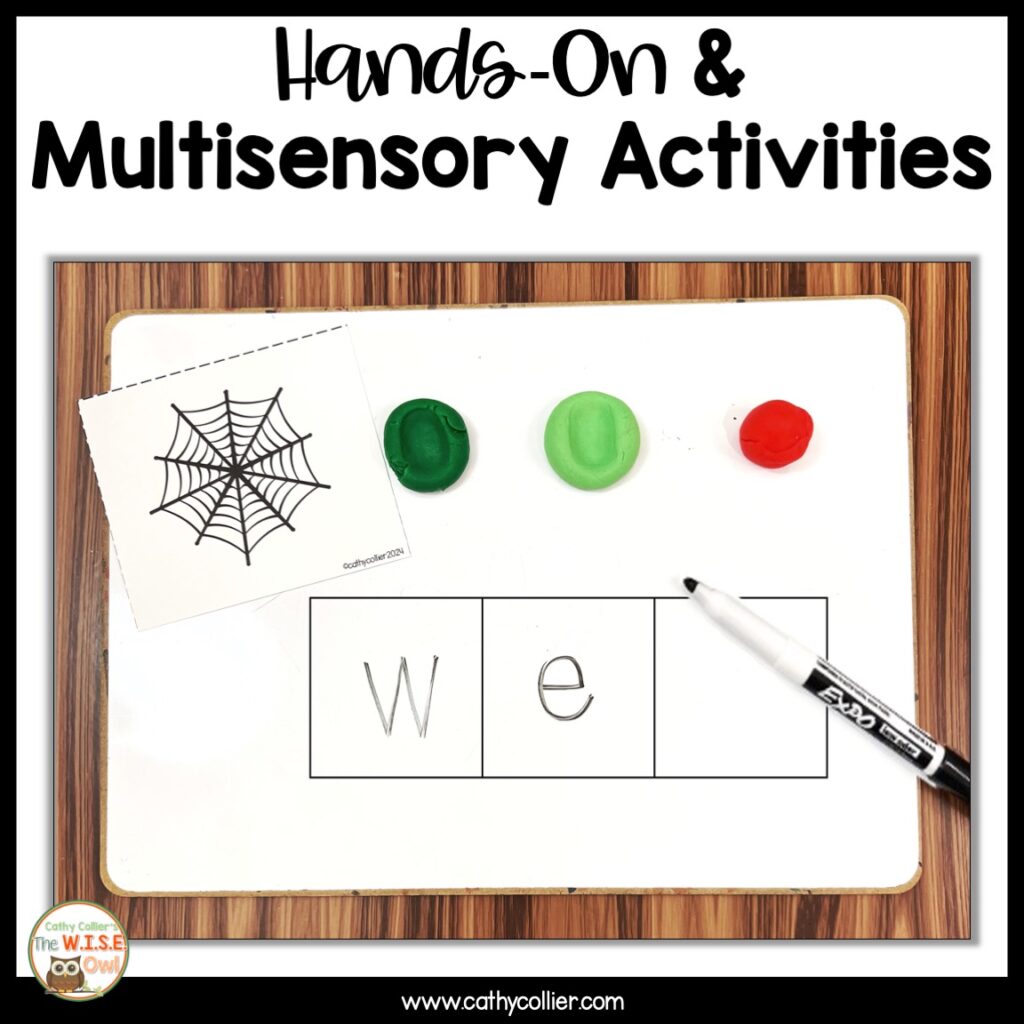
- Playdough or Sand Writing – Have students push a small ball of playdough or trace letters in sand in each box as they say each sound.
- Pom-Pom or Bean Counters – Students push a pom-pom or bean into each box as they segment a word.
- Hop & Say – Create a large Elkonin box on the floor and have students hop from box to box as they say each sound.
Elkonin boxes are an essential tool for helping students hear, segment, and manipulate sounds while strengthening their phonics and fluency skills. By incorporating hands-on and multisensory strategies, you can make word study more engaging and effective for small groups and intervention.
Elkonin boxes
- Are grounded in the Science of Reading.
- Promote phonemic awareness and phonics development.
- Support orthographic mapping and reading fluency.
- Provide a simple, visual way to make sounds in words more concrete.
They’re a small but mighty tool—especially powerful in K-1 classrooms and for intervention!
I created a set of Elkonin Box Cards and Mats. Need a resource that combines the best of word work practice and repetition? Need a way to practice segmenting, blending, and matching phonemic awareness and phonics? This set is perfect for whole group, small group, and independent practice. This set includes 372 cards (in both B&W and Full-Color) and 7 mats (with and without writing lines). Creating a method of practice these skills is essential for foundational reading and writing.
This set includes:
372 Cards: 2 Phoneme Cards (36 Cards), 3 Phoneme CVC Cards (60 Cards/12 per vowel), 4 Phoneme Blends Cards (87 Cards), 5 Phoneme Blends Cards (19 Cards),
3 Phoneme CVCe Cards (108 Cards), 4 Phoneme CVCe Cards (27 Cards), and
3 Phoneme Digraph Cards (55 Cards)
7 Mats: 2 Phoneme Mat, 3 Phoneme CVC Mat, 4 Phoneme Blends Mat, 5 Phoneme Blends Mat, 3 Phoneme CVCe Mat, 4 Phoneme CVCe Mat, 3 Phoneme Digraph Mat, snd Each also comes 4 to a page!


